
Usher Raymond: What Does It Mean When a Cultural Icon Collects Art?

Usher Raymond’s voice is an instrument that has soundtracked love, heartbreak, desire, celebration, and joy. He has built an enviable discography that sonically defined rhythm and blues for decades. Now, at the pinnacle of his career, on the heels of a record-shattering Las Vegas residency and a captivating Super Bowl performance, with nothing left to prove, Usher opened his home to Architectural Digest.
We expect celebrities to be meticulously styled to effortless effect, adorned in jewels and perhaps casually draped on a hand-tufted chaise, the kind of spread the recent AD feature could easily have been. Written by Jewel Wicker, photographed by Frank Frances, and styled by Mieke ten Have, the piece gave us something else: a man intentionally building a family life, and building it among extraordinary artwork.
Our lives are collected: the people we pull closest, the objects we gather, the experiences we keep. What we choose to live among says something about what we value. So what does Usher’s art collection tell us about the man behind the voice, and what does it mean when someone who has shaped popular culture for decades begins shaping a different kind of cultural legacy through collecting?
Born and bred in Atlanta, obsessed with R&B, classically trained in art history, and now an avid collector, I was especially excited to see such a thoughtful collection, one that tells an American story with unmistakably Southern notes. Pairing commissioned pieces by Lauren Halsey and Rashid Johnson with a photograph from Gordon Parks’ 1956 series for LIFE magazine is at once historically aware and attuned to the contemporary. And it isn’t recent. As he tells it in the piece, Usher commissioned his first work at twenty-one, from the muralist Retna, then taught himself by looking: museums, and the walls of the hotels he was living in on tour.
Perhaps more than anything else, the home reveals a Renaissance man. Music is only one expression of his creativity. Interior design, fashion, and fine art don’t exist independently of one another; they work together to compose a singular aesthetic point of view. Just as Usher has spent decades shaping songs through the way he sings them, he appears equally intentional about arranging the spaces in which his life unfolds. Taste, after all, is a creative act.
We often reserve the word “artist” for people who paint, sculpt, write, or sing. The best collectors understand that collecting is its own artistic practice. Every acquisition is an act of editing. Every room is a composition. Every decision reflects identity, memory, aspiration, and curiosity.
The collection demonstrates awareness and range without feeling scattered. It includes Nathaniel Mary Quinn, whose psychologically layered portraits weave together fragmented identity and personal history; Damien Hirst, one of the defining artists of our era; George Condo, whose commissioned portrait of Usher and his wife, Jennifer, bridges intimacy and contemporary portraiture; and Rashid Johnson, whose work has become one of the most important voices in contemporary American art.
What impressed me wasn’t simply who was on the walls. It was how the art lived within the home. The collection never feels like mere backdrop or a shorthand for wealth or status. The works are integrated into the architecture, into the rhythm of family life, into the experience of moving through the house.
A Rashid Johnson mixed-media ceramic tile mosaic sits beside the pool. I found myself asking why. There isn’t a single answer, but I loved the gesture. Too often we imagine important works tucked safely away in humidity-controlled rooms, protected from life itself. Here, the message feels different: art is meant to be lived with. It is meant to exist alongside laughter, children, conversation, water, sunlight, and everyday rituals. The mosaic isn’t isolated from joy; it becomes part of it.
The emphasis on family is equally striking. We see Usher’s sons Cinco, Naviyd, and Sire, along with his daughter Sovereign, in a home that treats art not as something adults collect but as something children grow up with. That is an extraordinary gift.
But the story begins at the front door.
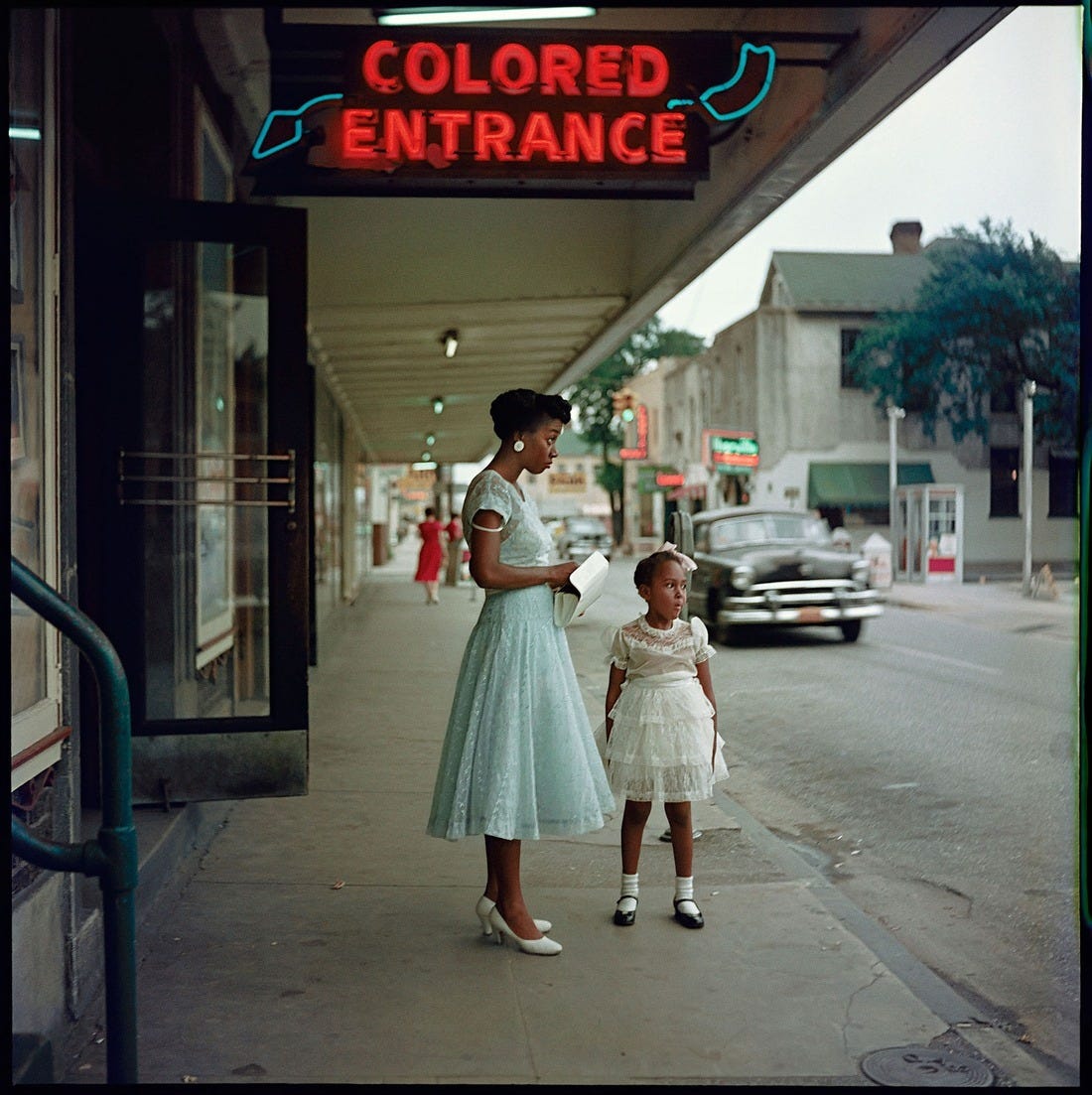
Before the architecture, before any of the names inside, there is a Gordon Parks photograph. Department Store, Mobile, Alabama, 1956, shot in color. Joanne Wilson stands with her niece in front of a department store, the two of them impeccably dressed in light summer frocks, and above them, a neon “Colored Entrance” sign clashes against their elegance, turning a casual afternoon outing into a document of overt discrimination. The image belongs to The Restraints: Open and Hidden, the 26-image color photo-essay Parks shot for LIFE in September 1956, following the extended Thornton family through daily life under Jim Crow in Mobile and Shady Grove, Alabama, work that went on to become one of the Civil Rights movement’s defining visual records.
I have my own history with this work. Gordon Parks died in March 2006, and I began drafting a congressional resolution honoring his life that day, working in the House of Representatives at the time. I have collected him since. I did not come to that photograph at Usher’s door as a stranger to it. Usher also has a history with Parks’ legacy; he co-chaired the Gordon Parks Foundation Awards Gala in 2017, with his son Naviyd beside him. In 2024, he supported the auction, acquiring two pieces.
I cannot map a person’s psychology through their home, but inferences can be made, particularly when Usher readily speaks about the importance of history in the piece. When Parks made that image, the artists whose work now hangs alongside it would have been largely shut out of the institutions that hold them today. The museums, the biennials, the market that assigns them value: those doors were closed too. Usher has placed the record of that exclusion at the entrance to a house full of the artists who came through on the other side of it.
Read that way, the collection stops being a list of names and becomes a lineage. Rick Lowe’s practice with Project Row Houses in Houston’s Third Ward made preservation itself the medium; his large-scale abstractions reference place and memory without figuration. Lauren Halsey archives her own neighborhood, the signage, storefronts, and vernacular of the South Central Los Angeles where her family has lived for generations, a place that is being remade around her as she records it. Parks documented Mobile in 1956. Lowe and Halsey are documenting Houston and South Central now. The difference is only when.
I know what it means to have your imagination shaped by living with art. My godmother, artist Tina Dunkley, gave me that gift. Being surrounded by extraordinary work changes the way you see the world. It teaches you to ask better questions. It expands your visual vocabulary long before you realize it’s happening. That may be one of the quiet legacies being built inside this home.
Ironically, the detail that stayed with me wasn’t a blue-chip painting at all. It was the preserved petals from Usher’s grandmother’s funeral, carefully protected beneath glass. Having recently lost my own father, I found myself returning to that image again and again. It reminded me that the most meaningful collections are never only about beauty or market value; they are repositories of memory. Life is always both-and. Joy and grief. Celebration and loss. The extraordinary and the deeply ordinary. The preserved petals acknowledge that our lives are shaped not only by what delights us but also by what breaks us. They quietly honor the people whose love continues long after their physical presence has disappeared.
Long after the tours have ended and the records stop climbing the charts, Usher Raymond’s music will continue to define generations. But the house makes a quieter argument. It belongs to someone who has been studying: not just collecting, but reading the line that runs from a photographer documenting a closed door to the artists who now hang on the other side of it. He could have bought beautiful things. He assembled a record instead, and then chose to live inside it, with his wife and their children, where they will grow up thinking this is simply what a home looks like.
No collection, and no life, is curated alone. Advisors, stylists, and collaborators shape what we gather until their eye becomes indistinguishable from our own. A nod, then, to everyone credited in the AD feature: writer Jewel Wicker, photographer Frank Frances, set stylist Mieke ten Have, fashion stylists Yashua Simmons and Jeremy Haynes, publicist Chris Chambers, and especially Nicole Fuller, Usher’s longtime designer and his partner on four homes now, including this one.
Beautifully written. Thank you for sharing!
Always loved that Gordon Parks piece. Also really appreciate his 1952 photos related to the publication of Ellison's Invisible Man.
Very cool to hear your connection to Parks via congressional resolution!